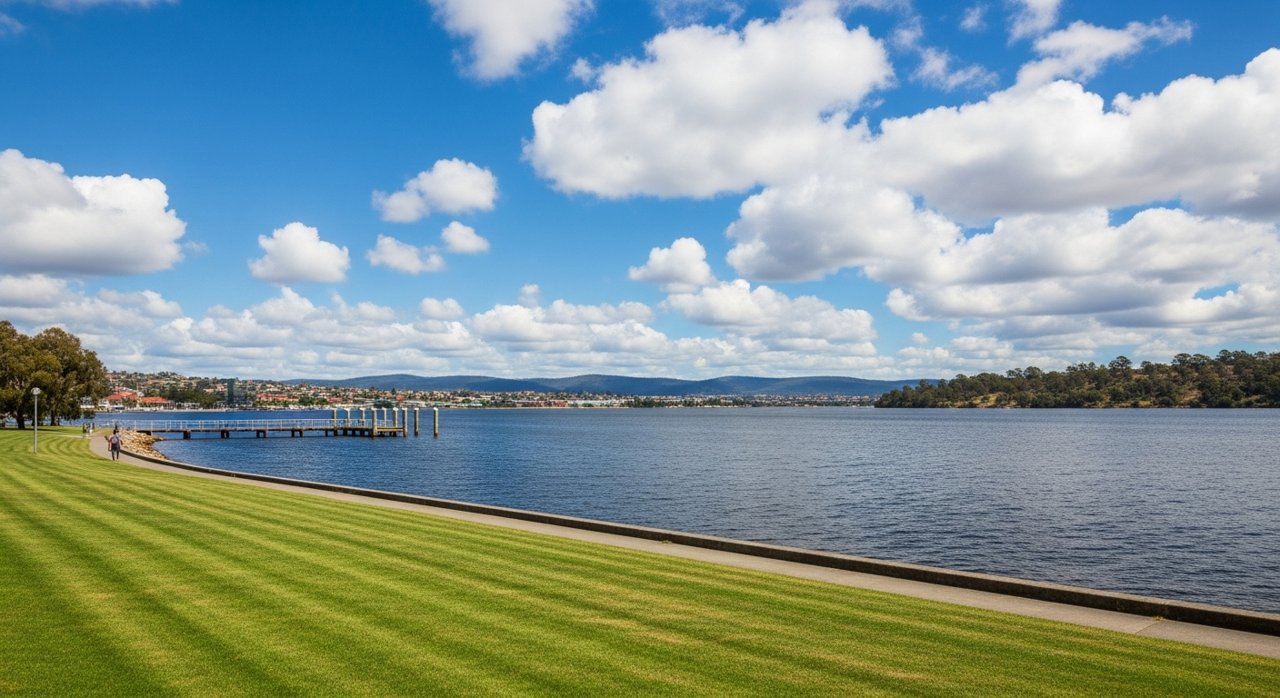
Residents along the Eastern Shore have likely noticed this week’s unusually high tides, with water levels visibly higher in the Derwent Estuary and along local beaches. According to an ABC Radio Hobart report, the phenomenon is the result of several factors aligning at once.
Australian National University climatologist Professor Janette Lindesay explained that the event is driven by a combination of astronomical tides and current weather patterns, the ABC reported. Professor Lindesay is an expert in atmospheric science and climate variability at the ANU Fenner School of Environment and Society.
The foundation of any high tide is the gravitational pull of the moon and sun. Tides are currently in a “spring tide” phase, which occurs when the Earth, moon, and sun are aligned, and their combined gravitational pull creates higher-than-average high tides.
Adding to this is the fact the moon is near its perigee, the point in its orbit where it is closest to Earth, according to the US National Oceanic and Atmospheric Administration (NOAA). This closer proximity increases the moon’s gravitational effect, leading to what is known as a “perigean spring tide,” sometimes called a king tide. These occur several times a year and can result in tides being significantly higher.
However, the astronomical alignment is only part of the story. The Bureau of Meteorology (BoM) has noted that a low-pressure system passing south of Tasmania is also contributing. Low atmospheric pressure has what is known as an “inverted barometer effect,” where less air pressure pushing down on the ocean allows the sea level to rise. According to Land Information New Zealand, a pressure drop of one hectopascal can cause the sea level to rise by one centimetre.
The BoM issued a coastal hazard warning for abnormally high tides for parts of the South East district, including Hobart and Lauderdale. The State Emergency Service (SES) also issued advice, warning that low-lying areas could be affected by flooding. Previous similar events have seen inundation of areas like South Arm Road at Lauderdale and jetties along the eastern shore.
This week’s event, as explained by Professor Lindesay to the ABC, serves as a clear example of how both predictable astronomical cycles and dynamic weather systems combine to affect sea levels along our coastline.