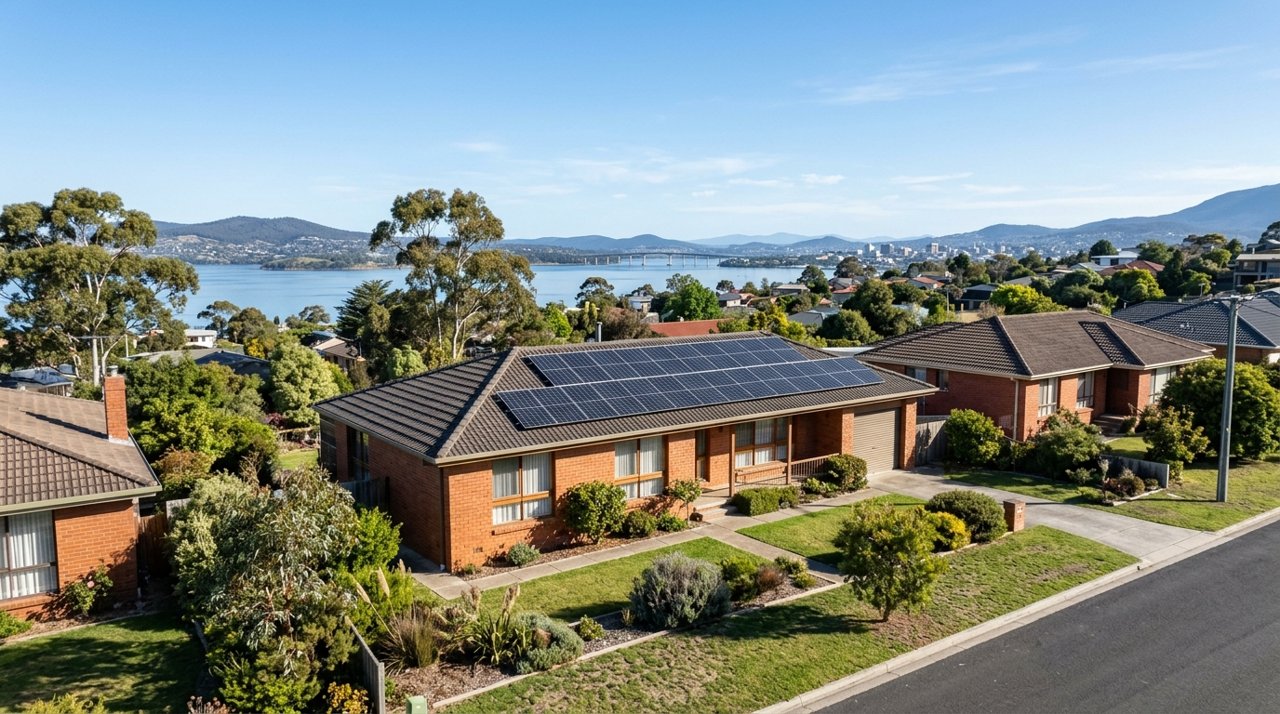
Hobart, TAS – Virtual Power Plants (VPPs) are gaining traction in Tasmania, with new community battery installations and a federal rebate making it easier for households with solar and home batteries to contribute to the state’s energy grid. While Tasmania’s hydropower-dominated network offers a more stable environment than mainland Australia, trials are progressing to integrate distributed energy resources more effectively.
TasNetworks Leads Community Battery Rollout TasNetworks is actively rolling out “Low Carbon Distributed Network Trials” across regional Tasmania, featuring the installation of eight community batteries. Two of these batteries, each with a capacity of 120kW / 258 kWh, were completed in Burnie and Howrah (on the Eastern Shore) in the second quarter of 2025. Six additional batteries, approximately 200kW / 400kWh each, are estimated for completion in the second quarter of 2026.
These community batteries, funded by the Australian Renewable Energy Agency (ARENA) and the Department of Climate Change, Energy, the Environment and Water (DCCEW), are designed to store excess solar energy from neighbourhood rooftop panels during the day. This stored energy can then be released back into the network during peak demand periods, helping to stabilise local power supply and potentially reduce the need for costly network upgrades. TasNetworks has introduced a trial “Storage Tariff” to support these community batteries, marking the first instance of two-way network charging in Tasmania.
Aurora Energy’s Residential VPP Program For individual households, Aurora Energy, Tasmania’s government-owned electricity retailer, offers the “Aurora Energy Battery Bonus” program. This is currently the only active residential VPP program in Tasmania. The program combines a capped flat retail electricity rate with optional VPP enrolment for battery owners, functioning more as a sign-up incentive than a per-event payment scheme. To be eligible, participants must be an Aurora retail customer with a compatible battery and a smart meter. As Aurora Energy serves customers statewide, including the Eastern Shore, households in these areas with eligible systems can join.
Federal Rebate Boosts Battery Uptake A significant development for Tasmanian households is the federal “Cheaper Home Batteries Program,” which commenced on July 1, 2025. This program provides an upfront discount on battery installations, potentially reducing the cost by around 30%. For an average 10 kWh battery system, this could mean savings of approximately $3,720, based on an estimated $372 per kWh. A key requirement for this rebate is that the installed battery must be “VPP-capable,” meaning it can support enrolment in a VPP, though actual participation remains optional. This initiative applies to homeowners, small businesses, and renters (with landlord approval) across Tasmania.
Participant Payments and Tasmanian Context While VPPs on mainland Australia often offer per-event payments, the financial returns for residential VPP participants in Tasmania are generally more modest. This is largely due to the state’s stable, hydropower-backed grid, which experiences less wholesale price volatility and fewer peak-demand events compared to the National Electricity Market. Typical annual earnings for participating Tasmanian households are estimated to be between $150 and $400. However, VPP enrolment can add $300–$900 per year to a household’s total solar income for those with a 10–13.5 kWh battery and average evening usage. The flat regulated feed-in tariff (FIT) of 8.93 c/kWh, determined by the Office of the Tasmanian Economic Regulator, also remains a competitive earning mechanism for solar households.
Beyond residential programs, Hydro Tasmania operates a VPP primarily for larger business assets, offering a revenue-sharing model for participants who help stabilise the grid by providing or storing energy.
The Australian Energy Market Operator (AEMO), in collaboration with ARENA, previously conducted VPP Demonstrations which concluded in 2021. These foundational trials aimed to inform regulatory changes and operational processes for integrating Distributed Energy Resources into the National Electricity Market. The insights from these demonstrations continue to shape the broader VPP landscape, including in Tasmania.